

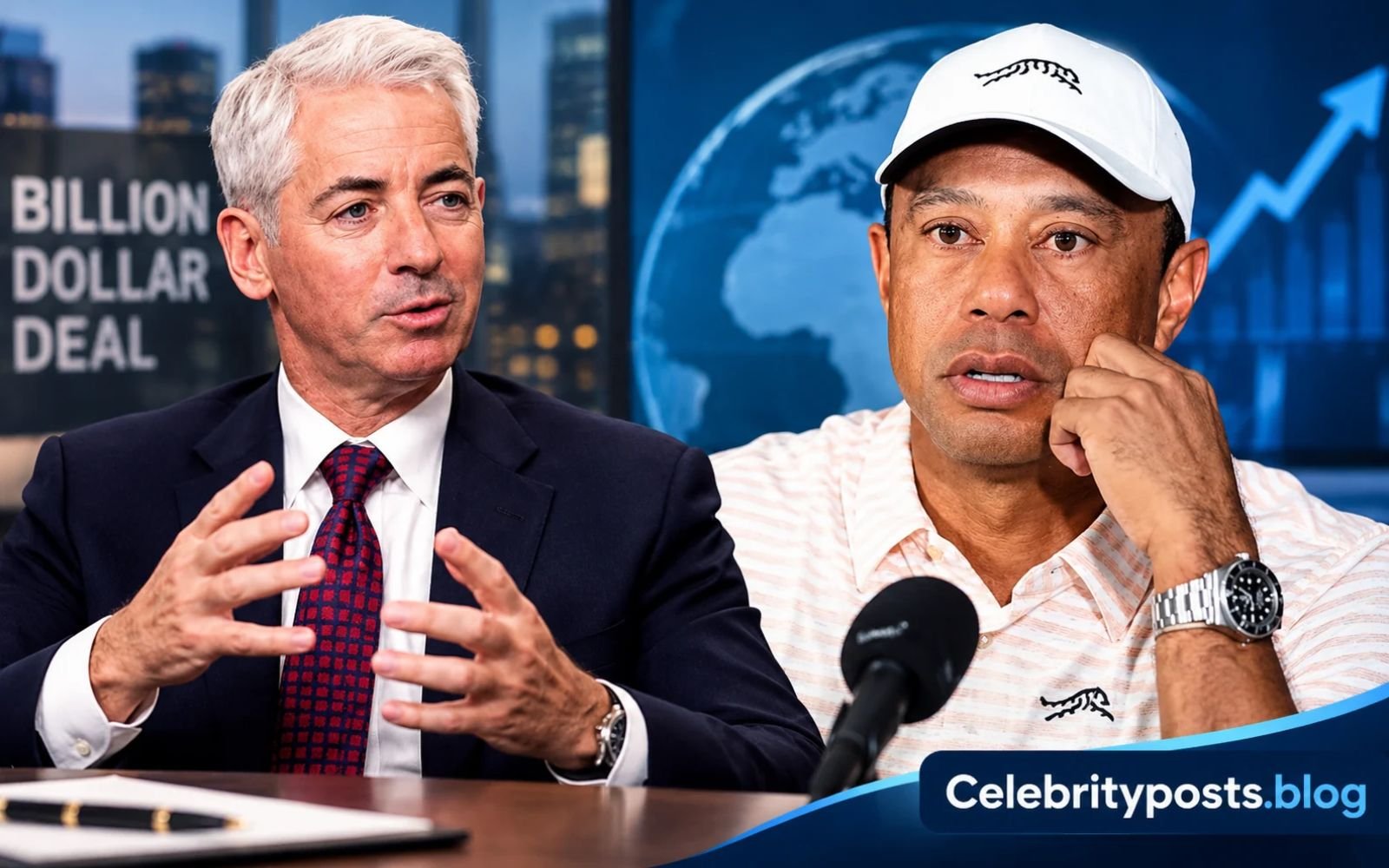
Few careers illustrate the different routes to public recognition as clearly as those of tiger woods and bill ackman. Woods became an international sporting figure through championship golf, setting records that place him among the game’s greatest players. Ackman built his reputation in investment management, becoming known for concentrated investments, corporate campaigns, and outspoken assessments of businesses.
Their stories belong to different professional worlds. Woods’s achievements are measured in tournament victories and major championships; Ackman’s career involves investment performance, ownership stakes, and corporate decisions. This combined biography examines their lives separately while exploring how professional success brought both men influence beyond their original fields.
Information Table: tiger woods and bill ackman
Ages in this profile are calculated as of October 24, 2026.
| Detail | Tiger Woods | Bill Ackman |
|---|---|---|
| Full name | Eldrick Tont Woods | William Albert Ackman |
| Date of birth | December 30, 1975 | May 11, 1966 |
| Age | 50 | 60 |
| Birthplace | Cypress, California, United States | Manhattan, New York City, United States |
| Nationality | American | American |
| Profession | Professional golfer, entrepreneur, golf course designer | Investor, investment manager, business executive |
| Education | Attended Stanford University from 1994 to 1996 | Harvard College bachelor’s degree; Harvard Business School MBA |
| Career beginnings | Turned professional in 1996 | Investment management career established during the 1990s |
| Known for | 15 major championships and 82 PGA Tour victories | Founding Pershing Square and activist investing |
| Philanthropic work | TGR Foundation | Pershing Square Foundation |
Woods’s biographical details are documented by golf institutions and his official records. Ackman’s educational credentials appear in his corporate biography, while published profiles establish his birth details and New York upbringing.
Tiger Woods: Early Life and Education
Tiger Woods was born in Cypress, California, to Earl and Kultida Woods. His father was a retired U.S. Army lieutenant colonel, and his mother was originally from Thailand. The nickname “Tiger” came from a Vietnamese friend of his father, connecting the name that became famous worldwide to a personal family history.
Woods’s progress through junior golf provided substantial evidence of his ability long before his professional debut. He won the U.S. Junior Amateur in 1991, 1992, and 1993, then followed those victories with U.S. Amateur championships in 1994, 1995, and 1996. These six consecutive USGA titles established a remarkable competitive foundation.
He entered Stanford University in 1994, combining college education with elite amateur competition. During two seasons, he won 10 collegiate events, including the 1996 NCAA individual championship. He left Stanford to turn professional that year, so his educational history should be described as university attendance rather than a completed Stanford degree.
For Woods, the transition to professional golf followed years of sustained achievement. His amateur record helps explain why expectations were already considerable when he began competing for prize money.
Tiger Woods’s Professional Breakthrough
The 1997 Masters
Woods’s victory at the 1997 Masters transformed his standing in professional golf. At 21, he became the tournament’s youngest champion, winning by 12 strokes. The combination of his age and extraordinary margin made the result a defining moment early in his career.
The significance extended beyond one tournament. Woods had arrived with exceptional amateur credentials, but Augusta demonstrated that his ability could translate into dominance at the highest professional level. His first major championship became the starting point for a career that would repeatedly reshape expectations about what a golfer could accomplish.
The Tiger Slam
Woods reached another extraordinary peak across 2000 and 2001. He won the 2000 U.S. Open, Open Championship, and PGA Championship, then captured the 2001 Masters. That sequence left him holding all four men’s professional major titles simultaneously.
Known as the “Tiger Slam,” the achievement crossed two calendar years. It therefore differs from winning all four majors within a single calendar year. His 2000 Open victory at St Andrews also completed his career Grand Slam, meaning he had won each of the four majors at least once.
Precision matters when describing these accomplishments. The career Grand Slam recognizes success across all four championships over a career; the Tiger Slam describes Woods holding their titles at the same time. Both belong among the central achievements of his biography.
Major Records and the 2019 Comeback
Woods’s record includes 82 PGA Tour victories, tying Sam Snead’s total, and 15 major championships. His major titles comprise five Masters victories, four PGA Championships, three U.S. Opens, and three Open Championships.
His later career also became a story of recovery. Injuries and repeated back operations interrupted his competitive life, creating uncertainty about whether he could again contend for the most important trophies.
The answer came at the 2019 Masters. Woods won his fifth green jacket and 15th major, ending an approximately 11-year wait since his previous major victory at the 2008 U.S. Open. At 43, he produced a comeback that added a different dimension to a career previously associated with overwhelming dominance.
His induction into the World Golf Hall of Fame followed in 2022. That recognition reflected an established body of work encompassing amateur excellence, professional records, and championship longevity.
Bill Ackman: Background and Harvard Education
Bill Ackman was born in Manhattan and grew up in Chappaqua, New York. His father, Lawrence “Larry” Ackman, worked in commercial real estate brokerage. This background placed business within his early environment, although his later investment career developed through his own education and professional ventures.
Ackman graduated from Harvard College with a Bachelor of Arts, magna cum laude, and later earned an MBA from Harvard Business School. These are completed qualifications, distinguishing his educational path from Woods’s decision to leave Stanford for professional sport.
The contrast between tiger woods and bill ackman is particularly clear at this stage. Woods built an elite competitive record while still a student, whereas Ackman pursued undergraduate and graduate education before establishing himself in investment management.
Their backgrounds do not support a single formula for success. They instead show how specialized ability, education, and professional opportunity can combine differently across careers.
From Gotham Partners to Pershing Square
Before Pershing Square, Ackman co-founded and co-managed Gotham Partners, an investment adviser managing public and private equity portfolios. His official corporate biography records that his work with Gotham continued until 2003.
Pershing Square became the defining platform of his career. Its corporate history dates the founding to 2003, while its philanthropic biography describes the investment firm as founded in 2004. Those dates reflect a distinction in the organization’s published accounts; broadly, the business emerged during that period.
Ackman became associated with a concentrated investment approach, placing substantial emphasis on a relatively small group of businesses. Pershing Square describes its preferred investments as durable companies with understandable operations, predictable characteristics, and strong cash generation. It also describes working actively with portfolio companies to create long-term value.
This approach helps explain the term “activist investor.” Such an investor may seek changes in management, governance, strategy, or financial structure rather than simply purchase shares and remain uninvolved.
Bill Ackman’s Notable Investments and Setbacks
Canadian Pacific and Corporate Change
Canadian Pacific became a significant example of Pershing Square’s involvement in corporate performance. The firm’s 2014 shareholder letter discussed substantial operating improvements at the railway, reporting that its operating ratio had improved faster than an earlier target anticipated.

The investment illustrates why Ackman’s reputation extends beyond selecting stocks. His public investment case often concerns how a business could operate differently and what that might mean for shareholders. Nevertheless, company performance results from the work of management, employees, boards, and broader market conditions; it should not be attributed to one investor alone.
Valeant and Herbalife
Ackman’s career also includes costly setbacks. Pershing Square’s 2016 shareholder letter acknowledged major losses associated with Valeant. That admission is essential to a balanced biography: his professional record includes investment judgments that did not deliver the intended outcome.
Herbalife became another highly publicized campaign. Pershing Square held a short position and argued against the company’s business model. Those arguments must be distinguished from regulatory findings.
In 2016, Herbalife agreed to pay $200 million for consumer redress and restructure its U.S. operations to settle Federal Trade Commission charges concerning deceptive earnings claims. The documented settlement provides a firmer basis for describing the regulatory outcome than treating every public accusation as an established fact.
The 2020 Pandemic Hedge
One of Pershing Square’s most notable financial outcomes came during the early COVID-19 market disruption. In a March 2020 investor letter, the firm reported exiting hedges for proceeds of $2.6 billion after paying $27 million in premiums and commissions.
The figures concerned the Pershing Square funds collectively. They were not Ackman’s personal earnings, an important distinction when discussing a transaction frequently summarized through dramatic headlines. The firm explained that the hedges offset losses in its equity portfolio during the market decline.
tiger woods and bill ackman Beyond Their Core Careers
Woods expanded into business through TGR, encompassing golf course design, events, hospitality, and philanthropy. TGR Design allowed him to apply his experience to the creation of golf facilities rather than solely to tournament play. His ventures demonstrate how an athlete’s professional identity can evolve into a broader enterprise.
He also became a player-owner of Jupiter Links Golf Club in TGL. The team’s announced ownership involved his TGR Ventures and sports investor David Blitzer. This is a documented business relationship and should not be confused with an assumed connection to Ackman.
Ackman’s business responsibilities have included leadership at Pershing Square SPARC Holdings and a position as executive chairman of Howard Hughes Holdings, effective from May 2025 according to his corporate biography. These roles demonstrate the breadth of his involvement across investment structures and operating-company governance.
Philanthropy and Public Influence
Philanthropy provides another useful perspective on tiger woods and bill ackman, although their organizations have distinct histories and priorities.
Woods and his parents founded what became TGR Foundation in 1996. Its development included the opening of a learning facility in Anaheim in 2006, broadening his public contribution into education. The foundation’s history places this work alongside his golfing career rather than presenting it as a retirement project.
Ackman co-founded the Pershing Square Foundation with Karen Ackman in 2006. Harvard documented the foundation’s support for research and other social initiatives, including a $17 million commitment announced in 2014.
Pershing Square Philanthropies identifies health and life sciences, education, economic development, and innovation among its areas of support. Its programs include cancer research and neuroscience initiatives. These activities form a substantial part of Ackman’s public work beyond investment management.
Understanding the Legacies of tiger woods and bill ackman
The clearest comparison between tiger woods and bill ackman concerns how achievement creates visibility and scrutiny. Woods’s tournament record supplies unusually concrete measures of sporting success. Ackman’s investment record requires attention to time periods, individual positions, fund results, and the difference between corporate assets and personal wealth.
Their stories also resist a simple narrative of uninterrupted progress. Woods’s comeback followed prolonged physical difficulties. Ackman’s celebrated investments sit alongside acknowledged losses. Understanding those reversals produces a more useful biography than focusing exclusively on victories or financial headlines.
Neither man’s significance depends on inventing a shared venture. Their individual careers already offer substantial material about ambition, professional judgment, and the responsibilities that accompany public influence.
FAQs About tiger woods and bill ackman
Who are tiger woods and bill ackman?
Tiger Woods is an American professional golfer and entrepreneur. Bill Ackman is an American investor and the founder of Pershing Square. They became prominent through separate careers in professional sport and investment management.
How old are tiger woods and bill ackman?
As of October 24, 2026, Woods is 50 and Ackman is 60. Woods was born on December 30, 1975, while Ackman was born on May 11, 1966.
Where did Tiger Woods and Bill Ackman study?
Woods attended Stanford University before turning professional in 1996. Ackman earned a bachelor’s degree from Harvard College and an MBA from Harvard Business School.
What are Tiger Woods’s biggest achievements?
Woods has 15 major championships and 82 PGA Tour victories. His achievements include the career Grand Slam, the 2000–2001 Tiger Slam, and the 2019 Masters comeback victory.
What is Bill Ackman best known for?
Ackman is best known for founding Pershing Square and pursuing concentrated investments and corporate campaigns. His public record includes Canadian Pacific, Valeant, Herbalife, and the funds’ highly profitable 2020 pandemic hedges.
Conclusion
The lives of tiger woods and bill ackman show how influence can emerge from very different disciplines. Woods established his place through exceptional amateur results, historic major victories, and a memorable return to championship success. Ackman built a prominent investment business whose history includes corporate campaigns, substantial gains, and consequential mistakes.
Their business and philanthropic activities extend those stories beyond golf courses and financial markets. Considered together, their biographies offer a grounded account of achievement, setbacks, and the lasting public impact of highly visible careers.







Leave a Reply