
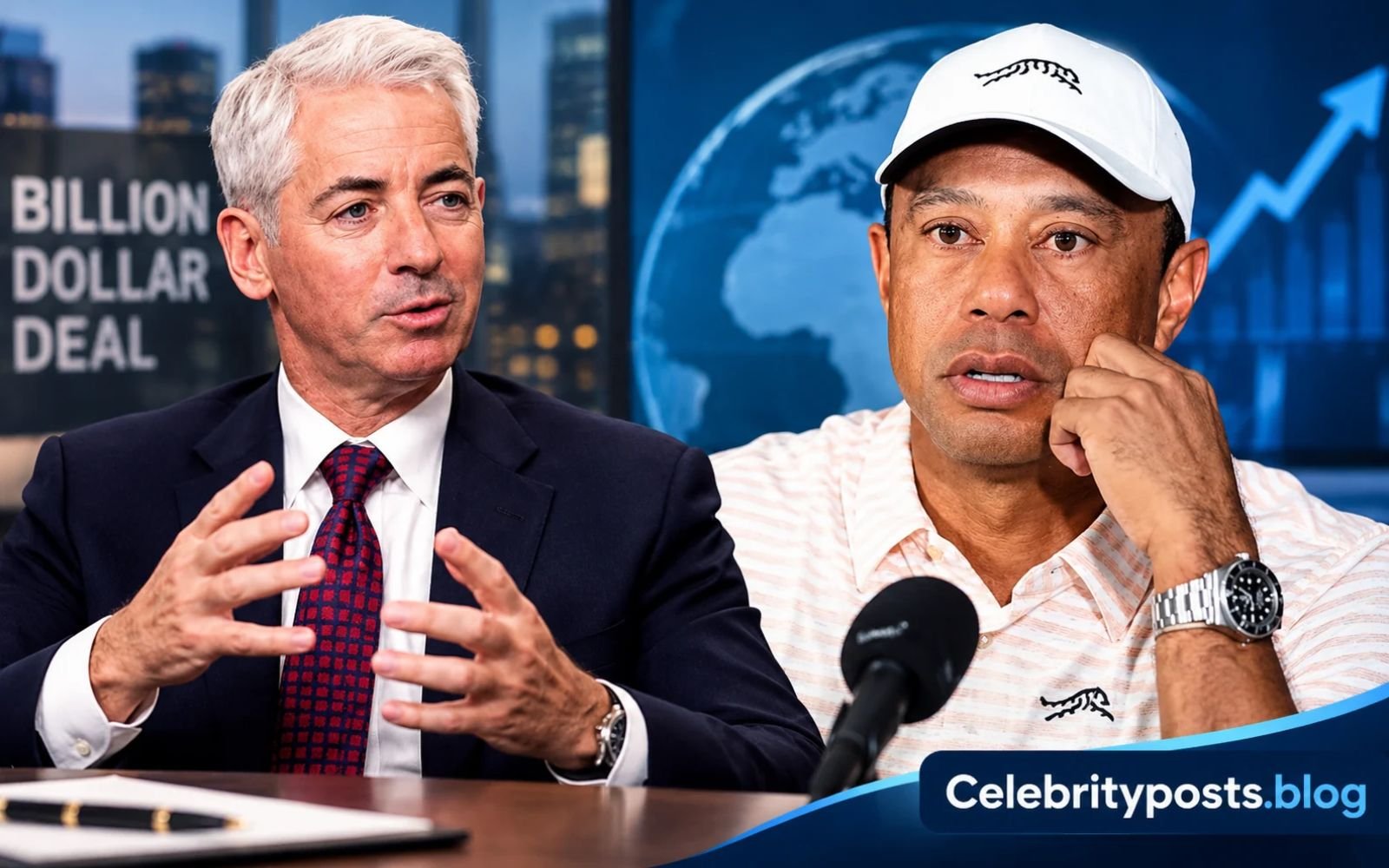
bill ackman and tiger woods built his reputation by investing in businesses and challenging how companies operate. Tiger Woods earned his place in sporting history through championship golf, sustained dominance and remarkable competitive returns. Their professions differ dramatically, but both have experienced the rewards and pressures of performing under public scrutiny.
A biography of bill ackman and tiger woods brings together two distinct American careers. Ackman’s story involves Harvard, hedge funds, corporate campaigns and philanthropy. Woods’ journey runs from amateur golf and Stanford University to major championships, business ventures and educational initiatives. Understanding their achievements requires looking beyond wealth and fame to the decisions and milestones that shaped each man.
Their individual histories reveal different routes to recognition, shaped by preparation, ambition and the ability to respond when circumstances changed.
Information Table: bill ackman and tiger woods
Ages below are calculated as of October 26, 2026.
| Detail | Bill Ackman | Tiger Woods |
|---|---|---|
| Full Name | William Albert Ackman | Eldrick Tont Woods |
| Date of Birth | May 11, 1966 | December 30, 1975 |
| Age | 60 | 50 |
| Birthplace | Manhattan, New York, United States | Cypress, California, United States |
| Nationality | American | American |
| Profession | Investment manager and business executive | Professional golfer and entrepreneur |
| Education | Harvard College, bachelor’s degree; Harvard Business School, MBA | Attended Stanford University, 1994–1996 |
| Career Beginning | Co-founded Gotham Partners in 1992 | Turned professional in 1996 |
| Known For | Pershing Square and activist investing | Major championships and record-tying PGA TOUR victories |
| Major Organization | Pershing Square Capital Management | TGR |
| Philanthropic Organization | The Pershing Square Foundation | TGR Foundation |
Bill Ackman’s Early Life and Education
William Albert Ackman was born on May 11, 1966, in Manhattan and raised in Chappaqua, a community in New York’s Westchester County. His father, Lawrence Ackman, worked in commercial real estate finance. This family background placed business within his early surroundings, although his later investment career developed through his own education and professional ventures.
Ackman graduated from Harvard College in 1988 with a Bachelor of Arts, magna cum laude. He subsequently attended Harvard Business School, earning his MBA in 1992. These qualifications preceded the investment career that would eventually make him a widely recognized figure in finance.
Education provides an interesting point of comparison when examining bill ackman and tiger woods. Both attended prominent American universities, but their routes differed. Ackman completed undergraduate and graduate degrees before building his investment business. Woods’ university years overlapped with an amateur sporting career that soon led him into professional competition.
Bill Ackman’s Investment Career
Gotham Partners and the Beginning of Pershing Square
Ackman co-founded Gotham Partners in 1992. The firm managed investments in public and private businesses, giving him experience that preceded the organization most closely associated with his name. He co-managed Gotham until 2003.
Pershing Square’s corporate history dates its founding to 2003. This is a useful distinction because accounts sometimes use different dates when discussing the firm’s formation and subsequent investment operations. The company’s own history identifies 2003 as its founding year.
Ackman became widely associated with activist investing. In this approach, an investor may acquire a substantial ownership position and press for changes to leadership, strategy, governance or capital allocation. The investment therefore involves a judgment about both the business’s value and the possibility of improving its performance.
This approach helped make Ackman a public figure beyond the investment industry. His campaigns often involved explaining a business argument publicly, giving shareholders and company leaders an opportunity to assess or challenge his position.
Canadian Pacific and Corporate Change
Canadian Pacific Railway became one of Ackman’s prominent investment successes. Pershing Square’s involvement demonstrated how an investment campaign could develop around operational and leadership changes rather than simply waiting for a share price to rise.
When Ackman exited the investment in 2016, contemporary reporting indicated that the sale freed approximately $1.5 billion for other opportunities. Total gains over the investment’s life were reported at approximately $2.6 billion. These were investment results associated with Pershing Square, rather than a personal salary paid to Ackman.
The distinction matters in a biography: the value of a fund’s holdings, its realized profits and its manager’s personal wealth describe different things. Canadian Pacific remains an important example of the potential rewards of his investment approach.
Valeant and Herbalife Setbacks
Ackman’s record also includes consequential failures. Pershing Square invested in Valeant Pharmaceuticals in 2015 and sold its remaining position in March 2017. Reporting subsequently placed the losses at approximately $4 billion. Ackman apologized to investors and acknowledged that the investment had been a mistake.
His campaign against Herbalife attracted extensive attention as well. Ackman publicly argued against the company’s business model and held a position designed to benefit from a decline in its shares. By February 2018, he had ended that bet. His allegations should be understood as his investment thesis and public claims, rather than repeated as an unqualified description of the company.
These episodes are essential to an accurate account. A biography focused only on profitable investments would omit decisions that tested his judgment and affected the investors who entrusted money to his firm.
The 2020 Market Hedge
In March 2020, Pershing Square generated approximately $2.6 billion in proceeds from hedges established as financial markets faced the emerging coronavirus crisis. Its investor report stated that premiums and commissions had totaled approximately $27 million.
The report also distinguished the proceeds received across Pershing Square’s funds from the approximately $2.1 billion attributable to Pershing Square Holdings. Those details help explain the transaction without turning a complex investment result into a misleading claim about personal earnings.
The episode became a notable part of Ackman’s career because it showed the impact that portfolio protection could have during an unusually severe period of market disruption.
Tiger Woods’ Early Life and Amateur Development
Tiger Woods was born on December 30, 1975, in Cypress, California. His parents were Earl and Kultida Woods. Golf became central to his childhood, and his competitive development was already well advanced before he entered university.
Woods attended Stanford from 1994 to 1996. During his two collegiate seasons, he won ten events, concluding with the 1996 NCAA individual championship. He was also a first-team All-American in both 1995 and 1996.
His amateur achievements extended beyond college competition. Woods won three consecutive U.S. Amateur championships, completing the sequence in 1996. Winning his third U.S. Amateur and the NCAA championship in the same year demonstrated the strength of his record immediately before turning professional.
For readers researching bill ackman and tiger woods, these early stages show different forms of preparation. Ackman developed through academic study and investment management; Woods combined university attendance with an already exceptional competitive record.
Tiger Woods’ Professional Career and Major Achievements
The Breakthrough at the 1997 Masters
Woods turned professional in 1996. The following April, he won the Masters by 12 strokes at age 21. The victory remains the tournament’s largest winning margin and established him as its youngest champion.
The result was significant for more than the trophy itself. A young player had overwhelmed one of golf’s strongest fields at a championship where experience usually carries considerable weight. His first major provided an early indication that his amateur achievements could translate to the highest professional level.
The performance also established Augusta National as a central setting in his career. His relationship with the Masters would eventually include five victories across more than two decades.
The Tiger Slam
Woods’ most celebrated period of dominance included the 2000 U.S. Open, which he won by 15 strokes. He also won that year’s Open Championship and PGA Championship, followed by the Masters in April 2001.
That sequence became known as the Tiger Slam. It meant he held all four men’s professional major titles simultaneously. Because the victories crossed two calendar years, the achievement is distinct from winning all four within a single calendar year.
The difference is important, but it does not diminish the accomplishment. It describes precisely what Woods achieved: uninterrupted ownership of golf’s four most important professional championship titles.
His success across these championships also demonstrated versatility. Winning on different courses and under different conditions required more than one reliable shot or a single preferred style of play.
Career Records and Championship Range
Official records credit Woods with 82 PGA TOUR victories, tying Sam Snead’s career total, and 15 major championships. His major victories comprise five Masters titles, four PGA Championships, three U.S. Opens and three Open Championships.
Another measure of his consistency is his streak of 142 consecutive cuts made between 1998 and 2005. Winning measures a player’s best weeks; repeatedly advancing to the final rounds demonstrates sustained competitive reliability across changing venues and conditions.
His achievements therefore encompass both exceptional peaks and prolonged consistency, two qualities that do not always appear together in elite sport.
The 2019 Masters Comeback
Woods won the Masters again in 2019, claiming his fifth green jacket and 15th major championship. Eleven years had passed since his previous major victory at the 2008 U.S. Open. That long interval made the victory a particularly significant chapter in his career.
Later in 2019, he won the ZOZO Championship to reach 82 PGA TOUR victories. These achievements added another major phase to a career already established through earlier dominance.
The 2019 season showed that his competitive story extended beyond the extraordinary performances of his twenties. It also gave his later career a defining achievement after years affected by physical problems.
Setbacks, Recovery and Public Scrutiny
The careers of bill ackman and tiger woods both include setbacks, although their circumstances should not be treated as equivalent. Ackman’s investment decisions exposed funds to financial losses. Woods’ later playing career was repeatedly interrupted by physical injuries and surgery.
Woods underwent spinal fusion surgery in 2017. A serious vehicle crash in February 2021 caused major injuries to his right leg, and he returned to major-championship competition at the 2022 Masters. In 2025, he underwent Achilles surgery and another back operation.
These documented events explain substantial interruptions without requiring speculation about his future competitive prospects. His lasting historical standing rests on recorded achievements. Assessing those achievements does not depend on predicting another comeback or assuming a particular retirement date.
Philanthropy and Work Beyond Their Main Careers
Philanthropy adds another dimension to the story of bill ackman and tiger woods. Ackman founded the Pershing Square Foundation in 2006. Its stated areas of work include health and life sciences, education, economic development and innovation.
Woods established his foundation in 1996. Its educational work includes learning opportunities, college preparation and experiences involving science, technology, engineering and mathematics. This gives his public legacy an institutional presence beyond tournament competition.
Woods also developed business interests through TGR, including golf-course design and event production. TGR Design, TGR Live and the TGR Foundation form part of his wider enterprise.
Ackman’s professional responsibilities have similarly extended beyond managing a portfolio. His roles have included executive chairman of Howard Hughes Holdings and leadership of Pershing Square SPARC Holdings.
These activities show how both men have built organizations around their professional reputations. Their work outside their original fields forms a meaningful part of their broader public biographies.
Understanding Wealth and Public Recognition
Financial comparisons involving bill ackman and tiger woods require care. An investment manager’s assets under management are not his personal property. Likewise, a golfer’s tournament earnings do not include every endorsement, business expense, investment or private liability.
Reliable public information does not establish an exact, continuously current personal net worth for either man. Published wealth rankings are estimates, and presenting them as audited balances would create false precision.
Their accomplishments are clearer when measured within their professions. Ackman’s record involves investment outcomes and corporate influence. Woods’ includes championship victories, competitive records and formal sporting honors.
Woods was inducted into the World Golf Hall of Fame in 2022 and received the USGA’s Bob Jones Award in 2024. These honors recognize a career whose significance extends beyond individual tournament results.
FAQs About bill ackman and tiger woods
Who are bill ackman and tiger woods?
Bill Ackman is an American investment manager and the founder of Pershing Square. Tiger Woods is an American professional golfer and entrepreneur with 82 PGA TOUR victories and 15 major championships.
How old are Bill Ackman and Tiger Woods?
As of October 26, 2026, Ackman is 60 and Woods is 50. Ackman was born on May 11, 1966, while Woods was born on December 30, 1975.
Where did Bill Ackman and Tiger Woods study?
Ackman earned a bachelor’s degree from Harvard College and an MBA from Harvard Business School. Woods attended Stanford University from 1994 to 1996 before turning professional.
What is Tiger Woods’ most famous championship sequence?
The Tiger Slam comprises his victories at the 2000 U.S. Open, Open Championship and PGA Championship, followed by the 2001 Masters. It gave him simultaneous possession of all four men’s professional major titles.
What is Bill Ackman best known for?
Ackman is best known for founding Pershing Square and pursuing prominent investments and activist campaigns. Canadian Pacific, Herbalife and Valeant are significant examples, with outcomes ranging from substantial gains to major losses.
Conclusion
The lives of bill ackman and tiger woods illustrate achievement in two demanding professions. Ackman’s career combines business analysis, corporate activism, profitable decisions and costly mistakes. Woods’ career brings together amateur excellence, historic championship performances and returns after serious physical setbacks.
Their significance also extends into organizations they have built and educational or philanthropic work they support. Viewed through verified milestones, both biographies offer more substance than celebrity rankings alone: they show how reputations develop through sustained work, consequential decisions and results that remain open to public examination.









Leave a Reply